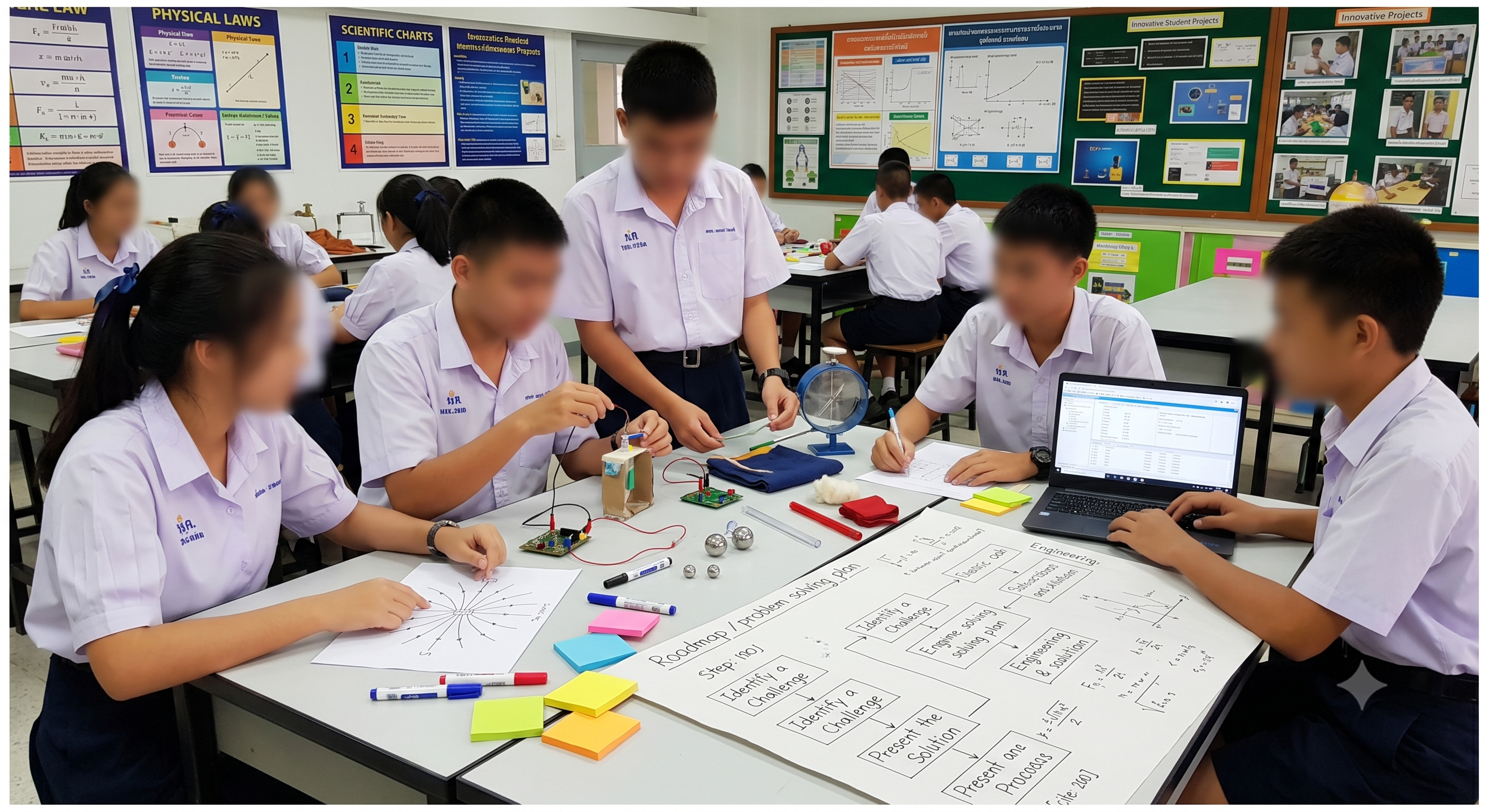
การส่งเสริมความสามารถในการแก้ปัญหาเชิงสร้างสรรค์ ของนักเรียนชั้นมัธยมศึกษาปีที่ 5 ที่เรียนด้วยการจัดการเรียนรู้ตามแนวคิดสะตีมศึกษา
Article Sidebar
Main Article Content
Abstract
Jirawat Chuprayoon and Pattawan Narjaikaew
รับบทความ: 1 เมษายน 2569; แก้ไขบทความ: 13 พฤษภาคม 2569; ยอมรับตีพิมพ์: 14 พฤษภาคม 2569; ตีพิมพ์ออนไลน์: 22 พฤษภาคม 2569
บทคัดย่อ
การวิจัยนี้มีวัตถุประสงค์เพื่อศึกษาและเปรียบเทียบความสามารถในการแก้ปัญหาเชิงสร้างสรรค์ของนักเรียน ชั้นมัธยมศึกษาปีที่ 5 ก่อนและหลังเรียนด้วยการจัดการเรียนรู้ตามแนวคิดสะตีมศึกษา ตัวอย่างเป็นนักเรียนชั้นมัธยมศึกษาปีที่ 5 ที่ได้เรียนรายวิชา ฟิสิกส์ 4 โรงเรียนขนาดใหญ่พิเศษแห่งหนึ่ง เขตพื้นที่อำเภอเมืองหนองคาย สังกัดสำนักงานเขตพื้นที่การศึกษามัธยมศึกษาหนองคาย ปีการศึกษา 2568 จำนวน 30 คน จาก 1 ห้องเรียน ได้จากการสุ่มตัวอย่างแบบกลุ่ม โดยใช้ห้องเรียนเป็นหน่วยสุ่ม ใช้แบบแผนการทดลองแบบกลุ่มเดียว ทดสอบก่อนเรียนและหลังเรียน เครื่องมือที่ใช้ในการวิจัย ประกอบด้วย 1) แผนการจัดการเรียนรู้ตามแนวคิดสะตีมศึกษา หน่วยการเรียนรู้ ไฟฟ้าสถิต จำนวน 4 แผน 2) แบบทดสอบความสามารถในการแก้ปัญหาเชิงสร้างสรรค์ เป็นแบบอัตนัย วิเคราะห์ข้อมูลโดยใช้ความถี่ ค่าเฉลี่ย ร้อยละ ส่วนเบี่ยงเบนมาตรฐาน ทดสอบสมมติฐานโดยการทดสอบทีแบบไม่อิสระต่อกัน และการทดสอบแบบทวินาม ผลการศึกษาพบว่า นักเรียนมีคะแนนเฉลี่ยความสามารถในการแก้ปัญหาเชิงสร้างสรรค์ก่อนเรียนเท่ากับ 11.57 (SD = 4.48) คิดเป็นร้อยละ 32.13 และหลังเรียนเท่ากับ 28.30 (SD = 2.53) คิดเป็นร้อยละ 78.61 โดยคะแนนเฉลี่ยหลังเรียนสูงกว่าก่อนเรียนอย่างมีนัยสำคัญทางสถิติที่ระดับ .05 นอกจากนี้นักเรียนทั้งหมดมีความสามารถในการแก้ปัญหาเชิงสร้างสรรค์อยู่ในระดับมากขึ้นไป เมื่อพิจารณาทิศทางการเปลี่ยนแปลงระดับความสามารถในการแก้ปัญหาเชิงสร้างสรรค์ระหว่างก่อนและหลังเรียนพบว่านักเรียนทุกคนมีทิศทางการเปลี่ยนแปลงความสามารถในเชิงบวกทั้ง 3 สถานการณ์ปัญหา
คำสำคัญ: การจัดการเรียนรู้ตามแนวคิดสะตีมศึกษา ความสามารถในการแก้ปัญหาเชิงสร้างสรรค์ ไฟฟ้าสถิต
Abstract
The study aimed to study and compare the creative problem-solving abilities of Grade 11 students before and after the implementation of a STEAM education approach. The sample consisted of 30 Grade 11 students enrolled in a Physics 4 course during the 2025 academic year at an extra–large secondary school in in Mueang Nong Khai District, under the Secondary Educational Service Area Office Nong Khai, Thailand. The participants were selected via cluster random sampling, with the classroom serving as the sampling unit. The research followed a one–group pretest–posttest design. The research instruments included: 1) four STEAM–based lesson plans focused on Electrostatics, and 2) a subjective test for assessing creative problem–solving abilities. Data were analysed using frequency, percentage, mean, and standard deviation, while hypotheses were tested using a dependent samples t–test and a binomial test. The results indicated that the students’ mean pre–test score was 11.57 (SD = 4.48), representing 32.13%, which significantly increased to a post–test mean score of 28.30 (SD = 2.53), or 78.61%. This improvement was statistically significant at the .05 level. Furthermore, all students achieved creative problem–solving abilities at a high level or above. Analysis of individual development revealed that every student exhibited consistent positive progress across all three assigned problem–solving situations.
Keywords: STEAM education approach, Creative problem–solving ability, Electrostatics
Downloads
Article Details

This work is licensed under a Creative Commons Attribution-NonCommercial 4.0 International License.
References
Inchai, P. (2022). From STEM to STEAM. Re-trieved from https://www.ipst.ac.th/news/ 28262/20220608-stem.html, August 20, 2025 (in Thai)
Isaksen, S. G., and Parnes. S. J. (1985). Curriculum planning for creative thinking and problem solving. Journal of Creative Behavior 19(1): 1–29.
Johnson, D. W., and Johnson, R. T. (1994). The New Circle of Learning Cooperation in the Classroom and School. Virginia: ASDC.
Khazanie, R. (1996). Statistics in a World of Applications. 4th ed. New York: Harper Collins College.
Lynn, M. R. (1986). Determination and quantification of content validity. Nursing Re-search 35(6): 382–385.
Narjaikaew, P. Chaodon, S., and Sarathanong, J. (2023). Installation and configuration of the air ware tubes on the volumetric flow rate of water: A STEM activity based on local wisdom. Journal of Research Unit on Science, Technology and Environment for Learning 14(2): 247–255. (in Thai)
Osborn, A. (1953). Applied Imagination: Principles & Procedures of Creative Thinking. New York: Charles Scribner’s Son.
Panich, V. (2015). Transformative Learning. Bankok: S.R. Printing Mass Products. (in Thai)
Papert, S., and Harel, I. (1991). Constructionism. Ablex Publishing Corporation. Retrieved from http://www.papert.org/articles/SituatingConstructionism.html, August 26, 2025.
Parnes, S. J., Noller, R. B., and Biondi, A. M. (1977). Guide to Creative Action. New York: Charles Scribner’s Son.
Piaget, J. (1954). The Construction of Reality in the Child. New York: Basic Books.
Polit, D. F., and Beck, C. T. (2006). The con-tent validity index: Are you sure you know what’s being reported? Critique and recommendations. Research in Nursing & Health 29: 489–497.
Srisa–ard, B. (2002). Introduction to Re-search. 7th ed. Bankok: Suweeriyasan. (in Thai)
Sukprasert, N. (2024). The development of physics learning activities based on design thinking approach STEAM education to enhance design thinking competency and innovative product of 10th grade students. Journal of Humanities and Social Sciences Mahamakut Buddhist University Isan Campus 5(1): 219–231. (in Thai)
Testong, N. (2022). The effects of science learning based on the STEAM education to promote the ability of innovation and attitude towards science of mathayomsuksa one students. Journal of Education, Silpakorn University 20(1): 274–288. (in Thai)
The Institute for the Promotion of Teaching Science and Technology [IPST]. (2020). Creative problem solving. IPST Magazine 48(222): 24–27. Retrieved from https://emagazine.ipst.ac.th/222/24/, May 5, 2025. (in Thai)
Torrance, E. P., and Myers, R. E. (1970). Creative Learning and Teaching. New York: Dodd.
Treffinger, J. D., Isaksen, G. S., and Dorval, K. B. (1994). Creative Problem Solving: An Introduction. Revised Edition. Sa-rasota, FL: Center for Creative Learning.
Treffinger, J. D., Isaksen, G. S., and Dorval, K. B. (2000). Creative Problem Solving: An Introduction. Third Edition. Waco, Texas: Prufrock.
Treffinger, J. D., Isaksen, G. S., and Dorval, K. B. (2003). Creative Problem Solving (Cps version 6.1) A Contemporary Framework for Managing Change. Retrieved from https://www.researchgate.net/publication/237616636_Creative_Problem_Solving_CPS_Version_61_A_Contemporary_Framework_for_Managing_Change, June 30, 2025.
Yosofa, D., and Lukma, H. N. (2025). STEAM–based learning on renewable energy topics in high school Physics for Grade X. Edu Sains 13(1): 1–15.