การผลิตสบู่เหลวจากน้ำมันปรุงอาหารใช้แล้ว
Article Sidebar
Main Article Content
Abstract
Production of Liquid Soap from Used Cooking Oil
Sanghom saijang, Lapatsarada Meethong, Nattaporn Hong–In and Natdanai Nirutmeteekul
รับบทความ: 26 กันยายน 2568; แก้ไขบทความ: 25 พฤศจิกายน 2568; ยอมรับตีพิมพ์: 6 ธันวาคม 2568; ตีพิมพ์ออนไลน์: 30 ธันวาคม 2568
บทคัดย่อ
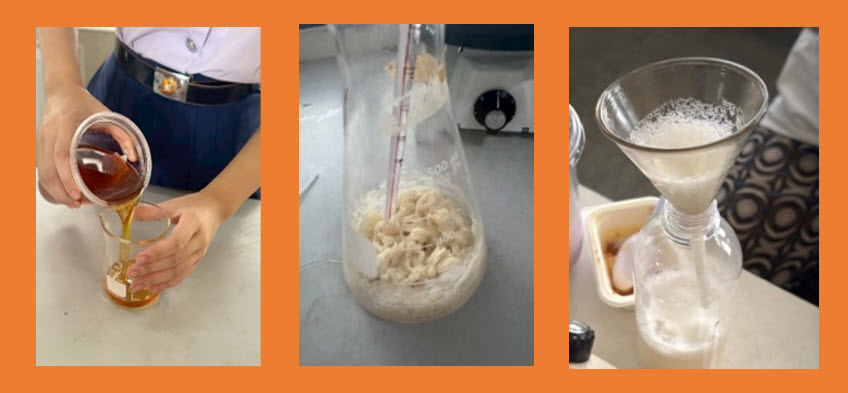
น้ำมันพืชใช้แล้วจากครัวเรือน หากทิ้งรวมกับขยะทั่วไปหรือขยะรีไซเคิลจะส่งผลกระทบต่อสิ่งแวดล้อมหลายด้าน การศึกษานี้มีจุดประสงค์เพื่อพัฒนาสบู่เหลวจากน้ำมันปรุงอาหารใช้แล้ว และทดสอบลักษณะทั่วไปของสบู่เหลวที่พัฒนาขึ้น ได้แก่ กลิ่น ความสม่ำเสมอของสี สิ่งแปลกปลอม การเป็นเนื้อเดียวกัน และคุณลักษณะทางเคมีของความเป็นกรด–เบส โดยกรองนำน้ำมันพืชที่ใช้แล้ว ปริมาตร 100 มิลลิลิตร ใส่ในขวดรูปชมพู่ ให้ความร้อนที่อุณหภูมิ 70 องศาเซลเซียส จากนั้นเติมสารละลาย KOH ปริมาตร 30 มิลลิลิตร เท็กซาพอน® ปริมาตร 30 มิลลิลิตร และเอทานอลความเข้มข้นร้อยละ 96 ปริมาตร 40 มิลลิลิตร คนให้เข้ากันอย่างทั่วถึงเป็นเวลา 120 นาที จะได้สบู่เบสที่มีความข้นและเป็นเนื้อเดียวกัน นำสบู่เบสละลายในน้ำกลั่นปริมาตร 100 มิลลิลิตร คนต่อจนได้สบู่เหลว นำตัวอย่างสบู่เหลวมาทดสอบด้วยอาสาสมัครจํานวน 20 คน ซึ่งชักตัวอย่างแบบเจาะจง เครื่องมือที่ใช้ในการเก็บรวบรวมข้อมูลประกอบแบบสัมภาษณ์ และเครื่องวัดค่าความเป็นกรด–เบส วิเคราะห์ข้อมูล โดยใช้สถิติเชิงพรรณนา ได้แก่ ความถี่ และร้อยละ และวิเคราะห์เนื้อหา จัดกลุ่มข้อมูล และเสนอข้อค้นพบของการวิจัย ผลการวิจัยพบว่า น้ำมันปรุงอาหารใช้แล้วสามารถนำมาใช้ผลิตสบู่ได้ โดยมีสีสม่ำเสมอ ไม่มีสิ่งแปลกปลอม และเป็นเนื้อเดียวกัน แต่ยังมีกลิ่นของน้ำมันพืชอยู่เล็กน้อยขณะใช้ และกลิ่นจางลงหลังเช็ดมือให้แห้ง สบู่เหลวมีค่าความเป็นกรด–เบสอยู่ในช่วง 8–9
คำสำคัญ: น้ำมันปรุงอาหารใช้แล้ว การผลิตสบู่ ลักษณะของสบู่
Abstract
Disposing of used cooking oil with general or recyclable waste poses multiple environmental risks. This study aimed to develop liquid soap from used cooking oil and evaluate its physical characteristics, including odor, color, consistency, presence of foreign matter, and homogeneity as well as its chemical characteristic of pH. The method involved filtering 100 mL of used cooking oil into Erlenmeyer flask, and heating it to 70°C. Subsequently, 30 mL of potassium hydroxide (KOH), 30 mL of Texapon®, and 40 mL of 96% ethanol were added. The mixture was stirred thoroughly for 12 min to produce a thick, homogenous soap base. The soap base was then dissolved in 100 mL of distilled water and stirred until it became liquid soap. The developed soap was tested by 20 participants who were selected by purposive sampling. Data instruments included an interview form and a pH meter. Data were analyzed using descriptive statistics, including frequency and percentage, as well as content analysis by grouping data and presenting the findings. The findings indicated that used cooking oil could be successfully provided for producing liquid soap with consistent color, absence of foreign matter, and homogeneity. However, a faint cooking oil odor persisted during use, which diminished after drying hands. The liquid soap had pH range of 8–9.
Keywords: Used cooking oil, Soap production, Soap characteristics
Article Details
Section

This work is licensed under a Creative Commons Attribution-NonCommercial 4.0 International License.
How to Cite
References
Chancharoen, K. (2022). Chula’s Potassium Liquid Soap from Used Cooking Oil for a Greener Environment and Circular Economy. Retrieved from https://www.chula.ac.th/en/highlight/89894/, July 17, 2025.
Dalimunthe, N. A. (2009). Pemanfaatan Minyak Goreng Bekas Menjadi Sabun Nandi Padat (Unpublished Master’s thesis). Universitas Sumatera Utara, Jurusan Teknik Kimia. (in Indonesian)
Downs, S. M., Nicholas, K., Linn, K. K., and Fanzo, J. (2022). Examining the trade–offs of palm oil 4 production and consumption from a sustainable diets’ perspective: Lessons learned 5 from Myanmar. Public Health Nutrition 25(5): 964–976.
Gusviputri, A., Njoo Meliana, P. S., Aylianawati, and Indraswati, N. (2017). Pembuatan sabun dengan lidah buaya (Aloe vera) sebagai Antiseptik alami. Widya Teknik 12: 11–21. (in Indonesian)
Hartini, S., Widharto, Y., Indarto, S. R., and Murdikaningrum, G. (2021). Eco–efficiency analysis of waste cooking oil recycling into liquid dish soap using life cycle assessment. IOP Conference Series: Earth and Environmental Science 896(1): 012066.
May, C. Y., and Nesaretnam, K. (2014). Research advancements in palm oil nutrition. European Journal of Lipid Science and Technology 116(10): 1301–1315.
Mucti, S., Purwasih, R., and Destiana, I. D. (2023). Analisis mutu minyak goreng yang dipakai oleh pedagang gorengan di pasar pujasera Subang. EDUFORTECH 8(2): 1–10. (in Indonesian)
Nababan, B. P., Mulmeyda, R., and Insyani, N. P. (2024). Utilization of used cooking oil in making liquid soap with the addition of water hyacinth (Eichhornia crassipes) leaf extract as an antibacterial. Chemistry and Materials 3(2): 64–70.
ReportLinker. (2023, March 15). Edible oil market in Thailand: Analysis and forecast to 2025. Retrieved from https://www.reportlinker.com/p06234567/Edible-Oil-Market-in-Thailand.html, July 17, 2025.
Taheripour, F., Hertel, T. W., and Ramankutty, N. (2019). Market–mediated responses confound policies to limit deforestation from oil palm expansion in Malaysia and Indonesia. Proceedings of the National Academy of Sciences 116(38): 19193–19199.