การพัฒนาสมรรถนะการประเมินและการออกแบบกระบวนการสืบเสาะหาความรู้ทางวิทยาศาสตร์ เรื่อง สมดุลกล โดยใช้การจัดการเรียนรู้โดยใช้ปัญหาเป็นฐาน (PBL) ของนักเรียนชั้นมัธยมศึกษาปีที่ 4
Article Sidebar
Main Article Content
Abstract
Panadda Kaewsrisung
Science Education Program, Graduate School, Udon Thani Rajabhat University, Udon Thani 41000, Thailand
Pattawan Narjaikaew*
Science Education Program, Faculty of Education, Udon Thani Rajabhat University, Udon Thani 41000, Thailand
*E-mail: tawannar@gmail.com, pattawan.na@udru.ac.th
รับบทความ: 1 พฤษภาคม 2569; แก้ไขบทความ: 8 กรกฎาคม 2569; ยอมรับตีพิมพ์: 11 กรกฎาคม 2569; Abstract online: 19 สิงหาคม 2569
บทคัดย่อ
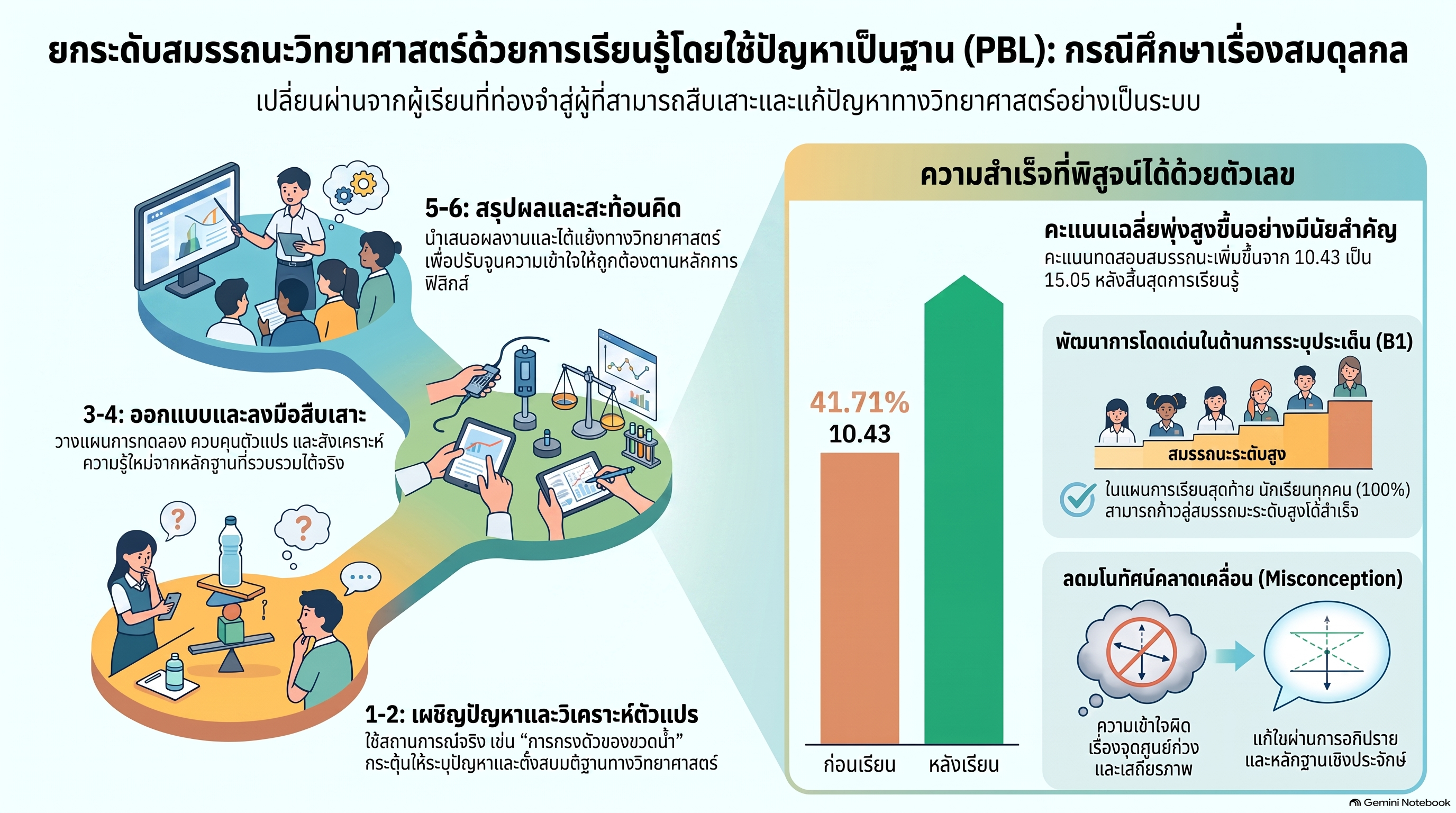
การวิจัยนี้มีวัตถุประสงค์เพื่อศึกษาและเปรียบเทียบสมรรถนะการประเมินและการออกแบบกระบวนการสืบเสาะหาความรู้ทางวิทยาศาสตร์ เรื่อง สมดุลกล ของนักเรียน ก่อนเรียน ระหว่างเรียน และหลังเรียนด้วยการจัดการเรียนรู้โดยใช้ปัญหาเป็นฐาน กลุ่มตัวอย่างคือนักเรียนชั้นมัธยมศึกษาปีที่ 4 จำนวน 21 คน ของโรงเรียนมัธยมศึกษาขนาดกลางแห่งหนึ่ง สังกัดสำนักงานเขตพื้นที่การศึกษามัธยมศึกษาสกลนคร ภาคเรียนที่ 2 ปีการศึกษา 2566 เครื่องมือที่ใช้ในการวิจัย ได้แก่ แผนการจัดการเรียนรู้โดยใช้ปัญหาเป็นฐาน จำนวน 5 แผน และแบบทดสอบวัดสมรรถนะการประเมินและการออกแบบกระบวนการสืบเสาะหาความรู้ทางวิทยาศาสตร์ เรื่อง สมดุลกล จำนวน 5 สถานการณ์ (สถาน-การณ์ละ 3 ข้อย่อย) ซึ่งครอบคลุม 3 ด้านหลัก ได้แก่ ด้านการระบุประเด็นทางวิทยาศาสตร์ (B1) ด้านการออกแบบกระบวนการสืบเสาะ (B2) และด้านการแปลความหมายและประเมินหลักฐาน (B3) วิเคราะห์ข้อมูลโดยใช้ค่าเฉลี่ย ส่วนเบี่ยงเบนมาตรฐาน และการทดสอบค่าที (t–test) ผลการวิจัยพบว่า 1) สมรรถนะการประเมินและการออกแบบกระบวนการสืบเสาะหาความรู้ทางวิทยาศาสตร์ของนักเรียนหลังเรียนสูงกว่าก่อนเรียนอย่างมีนัยสำคัญทางสถิติที่ระดับ .05 โดยมีคะแนนเฉลี่ยเพิ่มขึ้นจาก 10.43 คะแนน หรือร้อยละ 41.71 (SD = 2.89) เป็น 15.05 คะแนน หรือร้อยละ 60.19 (SD = 4.27) และ 2) สมรรถนะระหว่างเรียนทั้ง 3 ด้านมีพัฒนาการเชิงบวกอย่างต่อเนื่อง โดยด้าน B1 และ B2 ส่วนใหญ่พัฒนาสู่ระดับสูงในแผนการจัดการเรียนรู้สุดท้าย ขณะที่ด้าน B3 นักเรียนสามารถสรุปผลโดยอ้างอิงหลักฐานเชิงประจักษ์ได้อย่างแม่นยำยิ่งขึ้น และปรับเปลี่ยนมโนทัศน์ที่คลาดเคลื่อนให้ถูกต้องตามหลักฟิสิกส์ผ่านกระบวนการสะท้อนคิดและการอภิปรายแลกเปลี่ยนเรียนรู้ในชั้นเรียน
คำสำคัญ: การจัดการเรียนรู้โดยใช้ปัญหาเป็นฐาน สมรรถนะการประเมินและการออกแบบกระบวนการสืบเสาะหาความรู้ทางวิทยาศาสตร์, สมดุลกล
Abstract
The purposes of this research were to study and compare students’ competency in evaluating and designing scientific inquiry on mechanical equilibrium before, during, and after learning with problem–based learning. The sample consisted of 21 Grade 10 students from a medium-sized secondary school under the Secondary Educational Service Area Office Sakon Nakhon in the second semester of the 2023 academic year. The research instruments included: 1) five problem–based learning lesson plans, and 2) a test measuring competency in evaluating and designing scientific inquiry on mechanical equilibrium, covering three core aspects: identifying scientific issues (B1), designing scientific inquiry (B2), and interpreting and evaluating evidence (B3), comprising five situations with three sub–items each. Data were analyzed using mean, standard deviation, and t–test. The results revealed that: 1) students’ competency in evaluating and designing scientific inquiry after learning was statistically significantly higher than before learning at the .05 level, with the mean score increasing from 10.43 (41.71%, SD = 2.89) to 15.05 (60.19%, SD = 4.27); and 2) all three competencies during learning showed continuous positive progression, with most students reaching an advanced level in B1 and B2 by the final lesson plan, while in B3, students formulated evidence–based conclusions more accurately and corrected their misconceptions to align with physics principles through reflection and classroom discussion.
Keywords: Problem–based learning, Scientific competency in evaluating and designing scientific inquiry, Mechanical equilibrium
Downloads
Article Details

This work is licensed under a Creative Commons Attribution-NonCommercial 4.0 International License.
References
Chakkaew, P., Pewthongngam, L., and Juitong, S. (2016). Development of scientific competency in evaluating and designing scientific inquiry of grade 10 students on energy through problem–based learning. Journal of Research Unit on Science, Technology and Environment for Learning 7(1): 114–126. (in Thai)
Chantar, K. (2021). Effects of problem–based learning on collaborative problem solving competency and chemistry learning achievement of grade 11 students. Journal of Education Naresuan University 23(3): 112–125. (in Thai)
Gallagher, S. A. (1997). Problem–based learning: Where did it come from, what does it do, and where is it going. Journal for the Education of the Gifted 20(4): 332–362.
Huangfu, Z. (2022). Effect of Learning Management Using Problem–Based Learning Together with the Mobile Phone Application on Students’ Learning Achievement and the Ability of Land-scape Design of College Students. Master of Education (Curriculum and Instruction). Pathum Thani: Valaya Alongkorn Rajabhat University.
Kanjanawasee, T., and Kanjanawasee, S. (2018). Research Methodology. Bangkok: Pim Tanjai. (in Thai)
Khammani, T. (2023). Teaching Science: Knowledge for Effective Learning Process. 26th ed. Bangkok: Chulalongkorn University. (in Thai)
Lekhakul, A. (2005). Problem–Based Learning. Medical Education Resources, Prince of Songkla University. Retrieved from http://teachingresources.psu.ac.th/document/2548/Le_Kha_Kun/PBL.pdf, April 29, 2026. (in Thai)
Loylong, P. (2021). Development of problem-solving ability and learning achievement on motion and force using 5E inquiry and problem–based learning (PBL). Journal of Research Unit on Science, Technology and Environment for Learning 12(1): 45–60. (in Thai)
Malla, P. (2020). Effectiveness of Problem Based Learning Strategy in Teaching Mathematics. Master’s Thesis in Education. University Campus, Kathmandu, Napal.
McQuate, S. (2020). The Effects of Problem–Based Learning on Student Engagement in my Mathematics Classroom. Honors Projects, 536. Retrieved from https://scholarworks.bgsu.edu/honorsprojects/536, April 29, 2026.
PISA Thailand. (2023). PISA 2022 Results. Retrieved from https://pisathailand.ipst.ac. th/pisa2022-results, December 20, 2025.
Sinthapanon, S. (2015). Teaching Styles for Modern Teachers to Develop Learners’ Skills in the 21st Century. Bangkok: 9119 Technique Printing. (in Thai)
Somul, P. (2018). Development of Creative Problem Solving Ability of Grade 9 Students through Problem–Based Learning with Infographic Media. Master of Education Thesis (Educational Techno-logy). Nakhon Pathom: Silpakorn University. (in Thai)