
A Unified Bayesian Framework for Accurate, Fair, and Uncertainty-Calibrated Healthcare Insurance Pricing
DOI:
https://doi.org/10.69523/sej.2026.42.17187Keywords:
Bayesian deep learning, Healthcare insurance pricing, Algorithmic fairness, Uncertainty quantification, Explainable AIAbstract
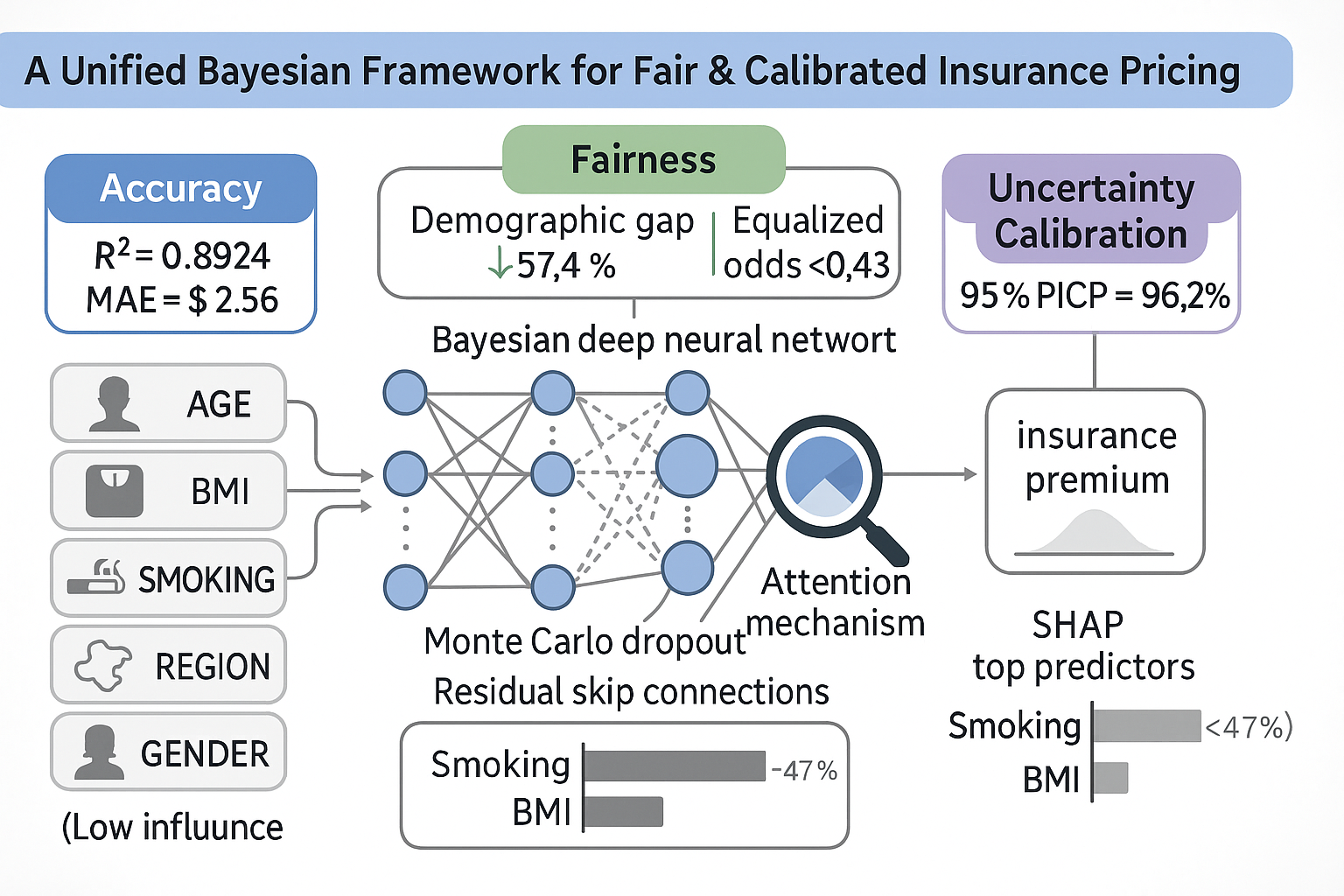
The integration of artificial intelligence (AI) into healthcare insurance pricing requires models that are not only accurate but also transparent, fair, and uncertainty-aware. This study introduces a unified ensemble Bayesian deep learning framework that combines Monte Carlo dropout, attention mechanisms, and residual connections to jointly optimize predictive accuracy, calibrated uncertainty quantification, and demographic fairness. Using the Kaggle medical insurance dataset (n = 2,772), the proposed model achieved R2 = 0.8924 and MAE = $2,156.73, outperforming established machine learning and deep learning baselines. The Bayesian approach yielded well-calibrated prediction intervals (95% PICP = 96.2%), improving coverage by 4.1% relative to residual-based methods. Fairness evaluation, measured at the 75th-percentile cost threshold, demonstrated a 57.4% reduction in demographic parity difference compared with XGBoost (0.079 vs. 0.1859), with equalized odds differences below 0.043 across gender, age, and region. SHAP and attention analyses confirmed smoking status (~47%) and BMI as dominant predictors, consistent with established clinical-economic evidence, while protected attributes exerted negligible influence. These results demonstrate that predictive accuracy, uncertainty calibration, and fairness can be co-optimized within a reproducible and auditable workflow. However, because the study relies on a modest, U.S.-only benchmark dataset with no clinical variables, the findings should be interpreted as a regulator-aligned proof of concept rather than a deployable regulatory solution. The framework illustrates the methodological components required for responsible AI in insurance pricing, while underscoring the need for temporal validation, external generalization assessment, and richer, multi-institutional datasets before real-world regulatory adoption.Downloads
Download data is not yet available.
Downloads
Published
2026-01-19
How to Cite
Sorn-In, K., Netayawijit, P., & Chansanam , W. . (2026). A Unified Bayesian Framework for Accurate, Fair, and Uncertainty-Calibrated Healthcare Insurance Pricing. Science Essence Journal, 42(1), 71–95. https://doi.org/10.69523/sej.2026.42.17187
Issue
Section
Research Article