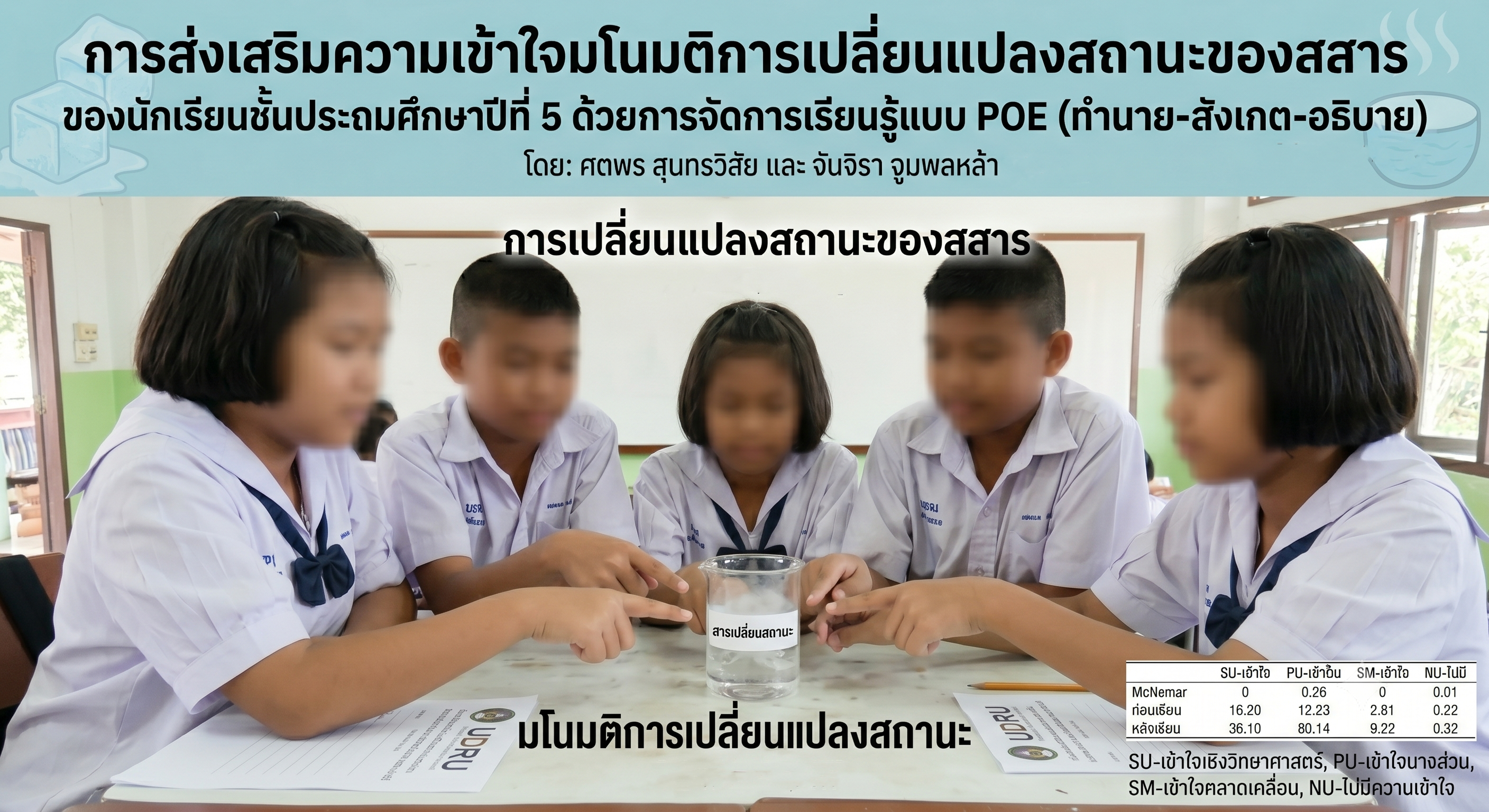
การส่งเสริมความเข้าใจมโนมติการเปลี่ยนแปลงสถานะของสสาร ของนักเรียนชั้นประถมศึกษาปีที่ 5 ที่เรียนด้วยการจัดการเรียนรู้แบบทำนาย–สังเกต–อธิบาย
Article Sidebar
Main Article Content
Abstract
Enhancing Grade 5 Students’ Conceptual Understanding of Changes in the State of Matter through Predict–Observe–Explain Learning Approach
Sataphon Soonthonwisai*
Science Education Program, Graduate School, Udon Thani Rajabhat University, Udonthani 41000, Thailand
*E-mail: chanchira659@gmail.com
Chanchira Joomphonla
Science Program, Faculty of Education, Udon Thani Rajabhat University, Udonthani 41000, Thailand
รับบทความ: 7 เมษายน 2569; แก้ไขบทความ: 18 พฤษภาคม 2569; ยอมรับตีพิมพ์: 26 พฤษภาคม 2569; ตีพิมพ์ออนไลน์: 17 มิถุนายน 2569
บทคัดย่อ
การวิจัยครั้งนี้มีวัตถุประสงค์เพื่อ 1) ศึกษามโนมติเรื่องการเปลี่ยนแปลงสถานะของสสารก่อนและหลังการจัดการเรียนรู้แบบทำนาย–สังเกต–อธิบาย (Predict–Observe–Explain: POE) และ 2) ศึกษาการเปลี่ยนแปลงมโนมติการเปลี่ยนแปลงสถานะของสสารของนักเรียนชั้นประถมศึกษาปีที่ 5 หลังจากการเรียนรู้แบบ POE ตัวอย่างที่ใช้ในการวิจัย คือ นักเรียนชั้นประถมศึกษาปีที่ 5 โรงเรียนประถมศึกษาแห่งหนึ่งในจังหวัดอุดรธานี จำนวน 17 คน เครื่องมือที่ใช้ในการวิจัยประกอบด้วยแผนการจัดการเรียนรู้แบบ POE จำนวน 4 แผน รวม 12 ชั่วโมง และแบบทดสอบความเข้าใจมโนมติการเปลี่ยนแปลงสถานะของสสารแบบ 2 ระดับ (two–tier test) จำนวน 16 ข้อ ซึ่งมีค่าความเชื่อมั่นเท่ากับ 0.90 สถิติที่ใช้ในการวิเคราะห์ข้อมูล ได้แก่ ความถี่ ค่าเฉลี่ย ส่วนเบี่ยงเบนมาตรฐาน ร้อยละ การทดสอบทีแบบไม่อิสระกัน และการทดสอบแมกนีมาร์ (McNemar test) ผลการศึกษา พบว่า นักเรียนที่เรียนด้วยการจัดการเรียนรู้แบบ POE มีคะแนนความเข้าใจมโนมติหลังเรียน (M = 36.10) สูงกว่าก่อนเรียน (M = 16.20) อย่างมีนัยสำคัญทางสถิติที่ระดับ .05 นอกจากนี้ก่อนเรียนนักเรียนส่วนใหญ่มีความเข้าใจมโนมติที่ไม่สอดคล้องกับแนวคิดทางวิทยาศาสตร์ร้อยละ 82.40 แต่หลังได้รับการจัดการเรียนรู้แบบ POE นักเรียนมีความเข้าใจมโนมติที่สอดคล้องกับแนวคิดทางวิทยาศาสตร์เพิ่มขึ้นเป็นร้อยละ 80.14
คำสำคัญ: การเปลี่ยนแปลงมโนมติ สถานะของสสาร การจัดการเรียนรู้แบบ POE
Abstract
This study aimed to: 1) investigate Grade 5 students’ conceptual understanding of changes in the states of matter before and after implementing the Predict–Observe–Explain (POE) approach, and 2) examine their conceptual changes resulting from this instructional method. The participants comprised 17 Grade 5 students from a primary school in Udon Thani Province. The research instruments included four POE–based lesson plans totaling 12 hours of instruction, and a 16–item two–tier conceptual understanding test with a reliability coefficient of 0.90. Data were analyzed using frequency, mean, standard deviation, percentage, dependent samples t–test, and McNemar’s test. The results revealed that students taught through the POE approach achieved a significantly higher posttest mean score (M = 36.10) than their pretest mean score (M = 16.20) at the .05 statistical significance level. Furthermore, prior to the intervention, the majority of students (82.40%) held misconceptions or alternative conceptions inconsistent with scientific principles. However, after experiencing the POE approach, the proportion of students demonstrating scientifically correct conceptions increased substantially to 80.14%.
Keywords: Conceptual understanding change, State of matter, POE learning approach
Downloads
Article Details

This work is licensed under a Creative Commons Attribution-NonCommercial 4.0 International License.
References
Bureau of Academic Affairs and Educational Standards. (2017). Indicators and Core Learning Content: Science Learning Area (Revised Edition B.E. 2017) according to the Basic Education Core Curriculum B.E. 2008. Bangkok: Agricultural Co–operative Federation of Thailand.
Coştu, B., Ayas, A., and Niaz, M. (2012). Promoting conceptual change in first year students’ understanding of evaporation. Chemistry Education Research and Practice 13(1): 5–16.
Driver, R., Squires, A., Rushworth, P., and Wood–Robinson, V. (1994). Making Sense of Secondary Science: Support Materials for Teachers. London: Routledge.
Liew, C. W., and Treagust, D. F. (1998). The effectiveness of predict–observe–explain tasks in diagnosing students’ understanding of science and in identifying their levels of achievement. Proceedings of the Annual Meeting of the American Educational Research Association (pp. 1–20). San Diego, CA: American Educational Research Association.
Narjaikaew, P. (2015). An alternative model represented relationship between time of moonrise/moonset and Thai time unit of Mong–Chao, Mong–Yen, Toom and Tee. Journal of Research Unit on Science, Technology and Environment for Learning 6(1): 106–115. (in Thai)
Narjaikaew, P., and Jeeravipoonvarn, W. (2014). Using inquiry–based learning supplemented with predict–observe–explain and analogy teaching strategies enhancing electric DC circuit conceptions of elementary school teachers. Journal of Research Unit on Science, Technology and Environment for Learning 5(1): 1–10. (in Thai)
Osborne, R. J., and Cosgrove, M. M. (1983). Children’s conceptions of the changes of state of water. Journal of Research in Science Teaching 20(9): 825–838.
Özcan, H., and Uyanık, G. (2022). The effect of predict–observe–explain strategy on students’ achievement and retention in science course. Journal of Science Education Research 8(2): 55–72.
Posner, G., Strike, K., Hewson, P., and Gertzog, W. (1982). Accommodation of a scientific conception: Toward a theory of conceptual change. Science Education 66: 211–227.
Rueangsri, N., Choomponla, C., Bojukrapan, S., and Deenang, E. (2024). Using predict–observe–explain learning approach supplemented with learning log to promote conceptual understanding of changes in substances among grade 5 students. Journal of Asian Language Teaching and Learning 5(3): 337–344.
Somprasong, M., and Narjaikaew, P. (2025). Model–based learning to enhance con-ceptual understanding of the changing earth of grade 8 novice monk students. Journal of Research Unit on Science, Technology and Environment for Learning 16(2): 187–197. (in Thai)
Sreebua, L., Jeeravipoolvarn, W., and Narjaikaew, P. (2015). Comparison of work and energy concepts and science process skills of grade 10 students between using 7Es learning circle supplemented with science activities and traditional teaching method. Journal of Research Unit on Science, Technology and Environment for Learning 6(2): 141–155. (in Thai)
Thorndike, E. L. (1932). The Fundamentals of Learning. New York: Teachers College.
White, R. T., and Gunstone, R. F. (1992). Probing Understanding. London: Falmer.
Wohankla, O., and Narjaikaew, P. (2018). Force and motion conception of grade 10 students learning through inductive instructional model supplemented with Polya’s problem solving process. Journal of Research Unit on Science, Technology and Environment for Learning 9(1): 76–92. (in Thai)
Worakham, P. (2013). Educational Research. 6th ed. Mahasarakham: Taksila. (in Thai)