
A Comparative Study of Confidence Intervals for the Parameter of the Inverse Xgamma Distribution
DOI:
https://doi.org/10.69523/sej.2026.42.17513Keywords:
Likelihood-based interval, Wald approximation, Studentized bootstrap, Monte Carlo simulation, Lifetime modelingAbstract
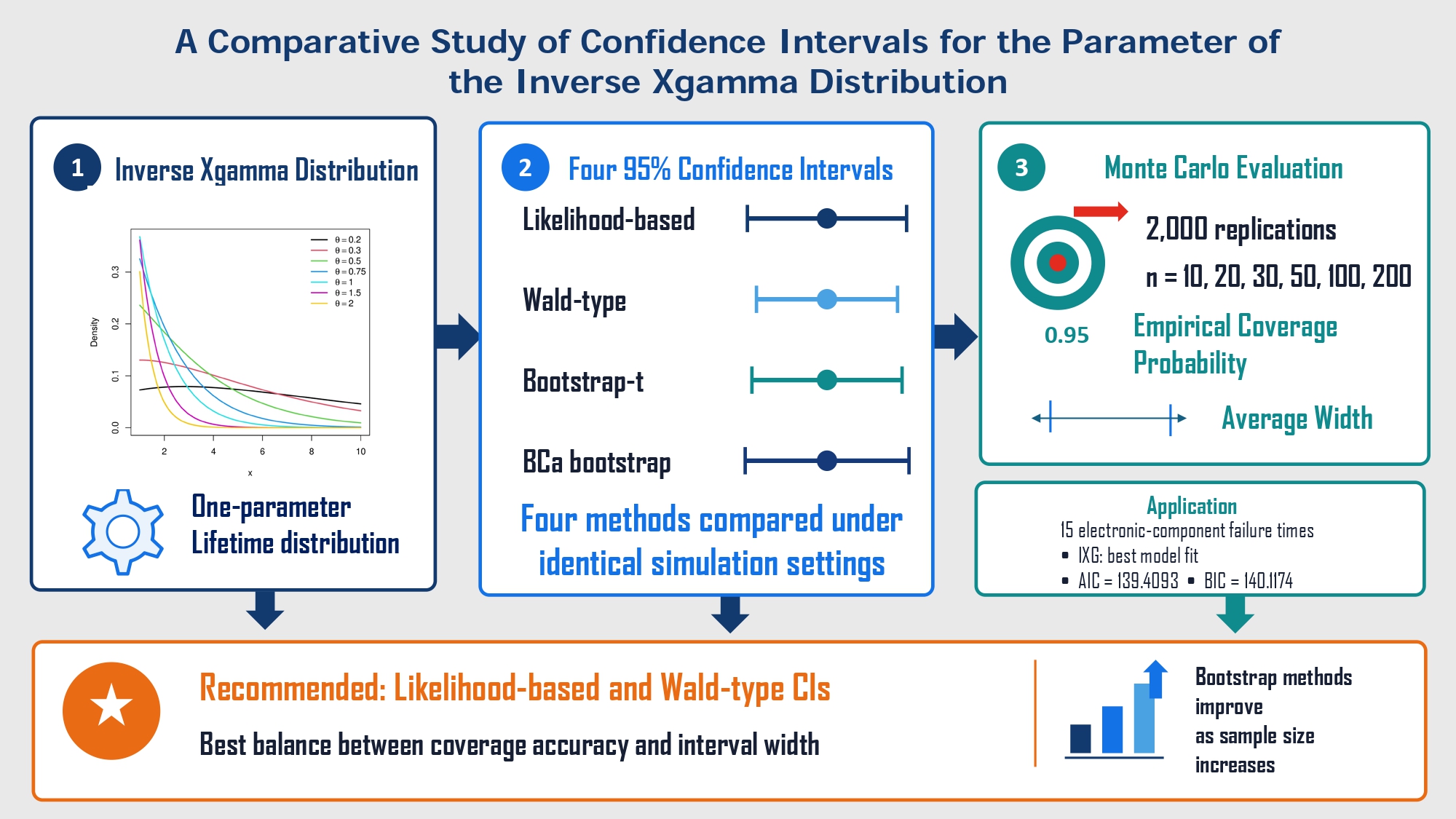
This study develops and evaluates four confidence interval (CI) procedures for the parameter of the inverse Xgamma (IXG) distribution: the likelihood-based, Wald-type, bootstrap-t, and bias-corrected and accelerated (BCa) bootstrap CIs. A Monte Carlo simulation study was conducted over a range of parameter values and sample sizes to assess their finite-sample performance in terms of empirical coverage probability and average width. The results show that the likelihood-based and Wald-type intervals generally achieved empirical coverage probabilities close to the nominal 0.95 level across most settings. The bootstrap-t and BCa bootstrap intervals tended to produce shorter intervals in some small-sample settings but exhibited noticeable undercoverage. Their coverage performance improved as the sample size increased, and the differences among the four methods became less pronounced for large samples. The proposed methods were also applied to failure-time data from 15 electronic components subjected to an accelerated life test. The IXG distribution provided the smallest Akaike and Bayesian information criterion values among the competing lifetime models considered. In addition, the Kolmogorov-Smirnov test and the probability-probability plot supported the adequacy of the fitted IXG distribution. For the real dataset, the likelihood-based and Wald-type intervals were narrower and relatively similar, whereas the bootstrap-t and BCa bootstrap intervals were wider and more asymmetric, reflecting greater small-sample uncertainty. Overall, the likelihood-based and Wald-type procedures provided the most favorable balance between coverage accuracy and interval width, particularly for small and moderate sample sizes.Downloads
Download data is not yet available.
Downloads
Published
2026-11-17
How to Cite
Thongjub, N. ., & Panichkitkosolkul, W. (2026). A Comparative Study of Confidence Intervals for the Parameter of the Inverse Xgamma Distribution. Science Essence Journal, 42(2), 306–328. https://doi.org/10.69523/sej.2026.42.17513
Issue
Section
Research Article